
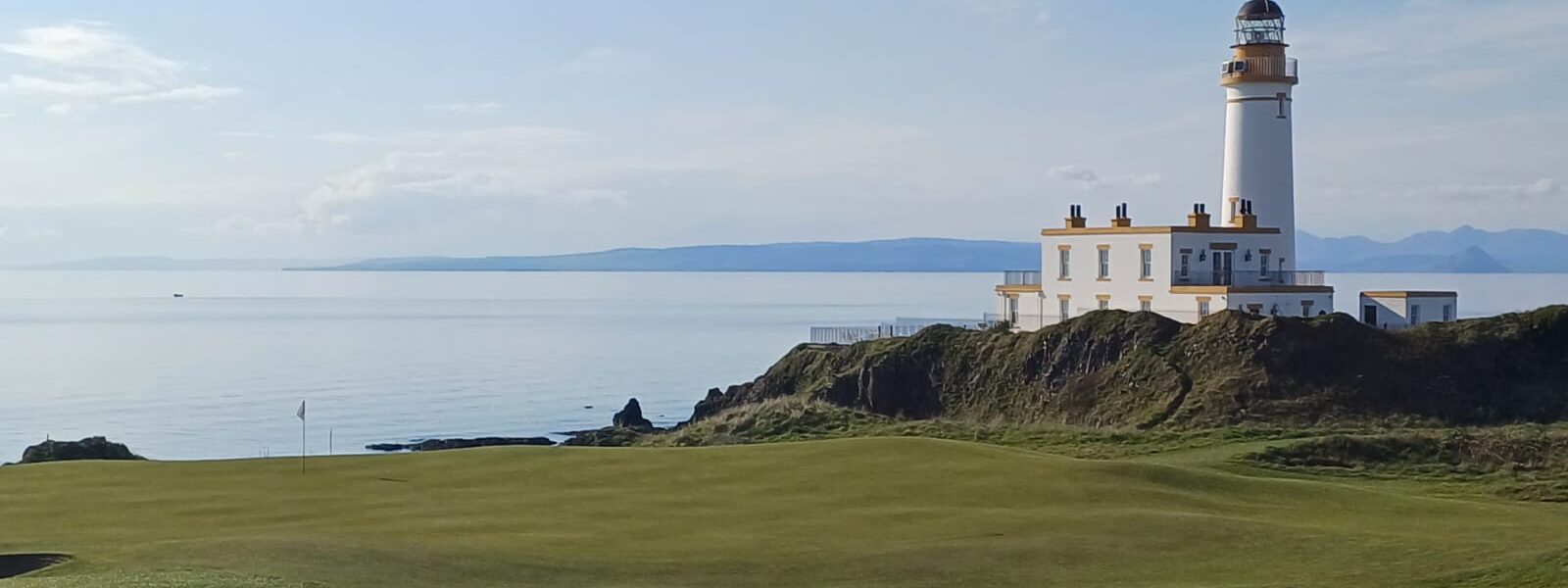
The College Links Golf team have already taken a look at our favorite short par threes. Here we look at the long one-shot holes which live long in the memory.
To qualify for consideration, the hole must measure 230 yards or more from the tips and require skill and judgment rather than sheer brute strength.
Do you agree with our choices? Email info@collegelinksgolf.com and let us know what you think!
Turnberry (Ailsa), 9th hole (248 yards)
The 9th at Turnberry (pictured above) was converted from a par 4 to a par 3 in 2016 and instantly became a world class short hole. Golfers play from a tiny tee atop a small rocky outcrop, over a sandy cove to a green perched between the shore and Turnberry’s iconic lighthouse. Pure golfing heaven.
Royal Aberdeen, 3rd hole (248 yards)
Royal Aberdeen gets off to a flying start with a succession of outstanding links holes. The 3rd is arguably the toughest of the lot. Playing downhill to large green with a raised front, choosing and executing the correct ball flight is crucial. Royal Aberdeen’s notorious pot bunkers lie in wait for anything loose.
Prestwick, 5th hole (231 yards)
The clue is in the hole name – “Himalayas”. From the tee all that can be seen is a wasteland of rough rising to a hilltop adorned with railway sleepers. Some sleepers are color-coded to indicate the flag position of a green hidden on the other side of the hill. Mad but fun.

Carrick, 14th hole (230 yards)
The Carrick, a modern layout on the banks of Loch Lomond near Glasgow, has the unique distincton of a front nine played in the Scottish lowlands and a back nine played in the Scottish highlands. The 14th (pictured above) plays from an elevated tee to a well-guarded green far below, with the loch and mountains in the background. Gorgeous.
Carnoustie, 16th hole (245 yards)
A particularly testing part of Carnoustie’s legendary closing stretch, the 16th has broken many hearts in major championships over the years. Five pot bunkers guard the entrance to a two-tiered green which measures nearly 50 yards from front to back. Any kind of wind multiplies the difficulty of the challenge.


