
It is 151 years since James Braid, one of golf’s great legends, was born in Earlsferry near St Andrews. The renowned club-maker, professional, golf architect, and World Golf Hall of Fame member won the Open championship five times and designed over 200 golf courses. His fame was enlightened by his place in the Great Triumvirate alongside Harry Vardon and JH Taylor, the three leading British golfers of the 19th and early 20th century period.
The roll-call of Braid’s course designs – originals or extensions/revisions – reads like a greatest hits list of golf courses. They include prestigious venues such as Carnoustie, Nairn, Royal Troon and the Kings and Queens courses at Gleneagles, as well as must-play village gems including Brora, Royal Musselburgh and Fortrose & Rosemarkie.
Braid was a thinking golfer’s course designer. He could visualise how a hole could be created from the natural lie of the land. His bunkering tested the slightly wayward shot, not those of a novice. He thought deeply about variety, wind direction, turf condition, green size, tee positions and he sought to give pleasure and challenge to all golfers. For these reasons the basic layouts of Braid’s courses are often intact today, merely enhanced or modified for modern equipment and tastes.
A tour of Scotland, incorporating some of Braid’s masterpieces, is an opportunity to experience some of the very best layouts the game has to offer. We’ve put together a James Braid Trail tour which features an array of courses which showcase his brilliance as a designer. If you’d like to find out more about this tour, or any there College Links tour options, we’d love to talk to you. Click here to get in touch.
Day 1: Dunbar Golf Club
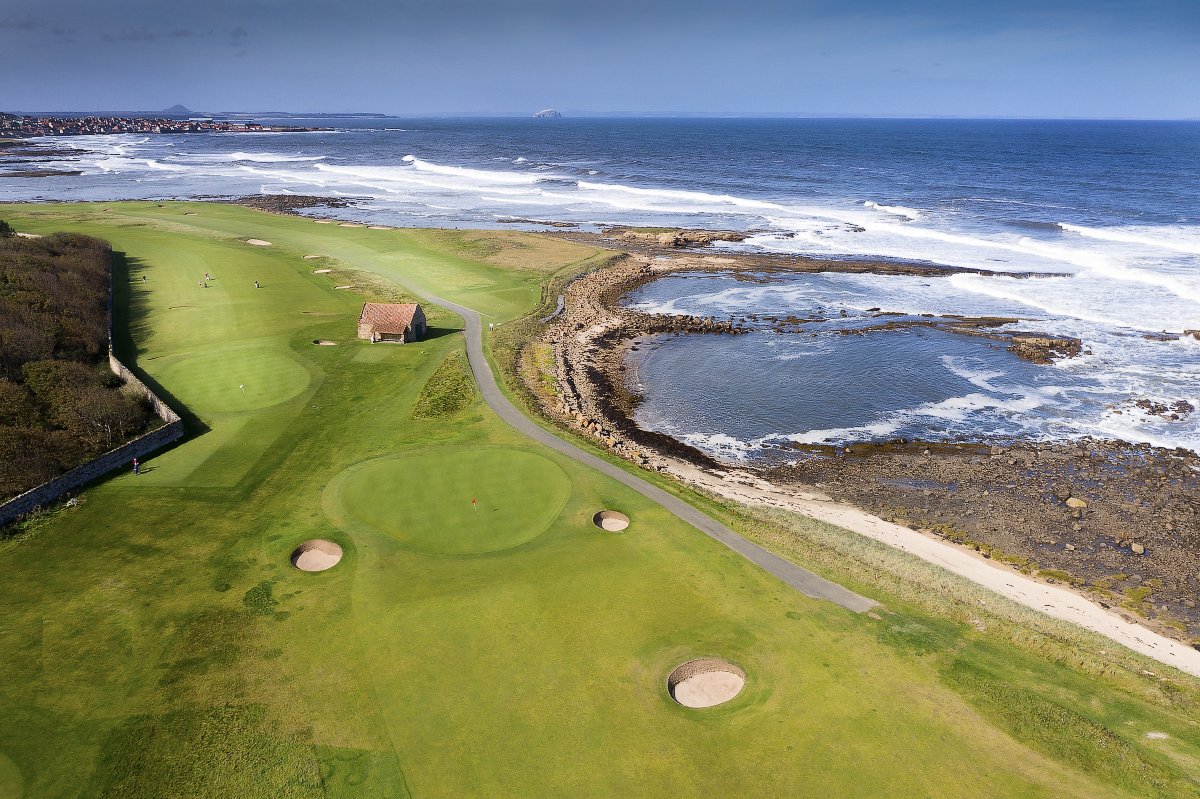
We get things started at Dunbar, a lovely links some 45 minutes drive from Edinburgh. The course’s most memorable feature is its shoreline holes. The North Sea comes into play on six holes, perhaps most memorably at the 12th, a long par four playing to a green situated on the edge of a beach.
Braid, along with North Berwick professional Ben Sayers, was brought in to redevelop the links here between 1922 and 1924 and today’s course is very similar to the layout they completed.
Day 2: Lundin Links
Lundin Links, on Fife’s southern coast, is an unusual mix of parkland and seaside golf. The opening and closing stretches are pure links, plotting a course through sandhills and dunes. The middle section, much of it laid out on higher ground, is very different in character with trees coming into play and noticeably softer ground. This split personality is reflected in two of the course’s best holes. The 13th is a short par five, threaded between woodlands, which can be reached with two good shots, while the 18th is a thrilling closing par four, funnelled between two sand dunes.
Golf had been played over Lundin Links since the middle of the 19th Century, but today’s course is based on the layout completed by Braid in the Autumn of 1909 . . . for the princely sum of £143!
Day 3: Panmure Golf Club
Panmure’s location, just a few minutes’ down the road from Carnoustie, proved to be a blessing in 1953 when Ben Hogan chose the course as his ‘training camp’ for his one and only crack at the Open Championship. It was here that Hogan acclimatised himself with the unique challenges of links golf before going on to claim the Claret Jug. Hogan chose well. Panmure is a classic links with some outstanding holes where shotmaking, rather than power, is key. His favourite hole was the sixth, a testing par four with a green wedged hard against a railway line. It was Hogan who suggested placing a pot bunker to the front of the putting surface. It has since been named ‘Hogan’s Bunker’ in his honour.
Braid was invited to provide suggestions for revisions to the layout at Panmure in 1922, many of which were incorporated and remain in place to this day.
Day 4: Carnoustie
The Championship Course at Carnoustie has a fearsome reputation as one of the toughest tests in tournament golf. While this reputation is well-earned it sometimes clouds the fact that this is a supremely fair layout. There are few forced carries or blind shots and the modest golfer is nearly always presented with an alternative to the risky shot. For a player chasing a low score, however, dangers abound and this is never more apparent than on Carnoustie’s legendary closing stretch. The 16th, 17th and 18th are a defended by a grim combination of pot bunkers, out of bounds and water hazards which can derail even the most promising of rounds in the most dramatic fashion.
Braid was brought in to revamp the links at Carnoustie in 1926, with a brief to make it a course worthy of hosting the Open Championship. Nobody who has played here would suggest he failed.
Day 5: Blairgowrie (Rosemount)
We turn out back on the see and head into the Highlands to play a heathland gem which bears the imprint of not one, but two, of the game’s great designers. The Rosemount Course at Blairgowrie weaves its way through forests of birch and pine to spectacular effect. The tenth, for instance, is a short par five which gently dog-legs from right to left. A well placed drive brings the green into range on the second shot but any player who gets out of position off the tee will face serious difficulties in making par.
The Rosemount layout was originally designed by Alistair Mackenzie, who came to prominence for his work at Augusta National and Cypress Point, and opened for play in 1927. Braid was retained a few years later to make further adjustments and the today’s course bears the hallmark of both men.
Day 6: Gleneagles (Kings & Queens courses)
 We stay in the Highlands today for 36 holes at one of the world’s great golfing resorts – Gleneagles. The Kings and Queens courses are heathland gems laid out on a majestic scale. Undulating fairways sweep towards sumptuous green complexes, set amongst some of the most spectacular scenery Scotland has to offer. The longer Kings course features huge putting surfaces and cavernous bunkers, while the Queens is more intimate in scale, with tighter landing areas, smaller greens and a seemingly infinite supply of stunning viewpoints.
The Kings is considered by many to be Braid’s masterpiece. It opened for play in 1919 to instant acclaim. Work was completed on the Queens, another Braid design, in 1917 and together the courses provide a near perfect conclusion to our James Braid Trail.


