

Our latest top five focuses on the fear factor. We’re taking a look at the single shots that will increase the heart rate of every golfer due to the unique nature of their challenge. Have we got our choices right? Speak to us about a tour to Scotland and find out for yourself!
First tee, Old Course
It should be the easiest shot in golf. The opening fairway at St Andrews Old Course is shared with the 18th and measures more than 100 yards across. Sure, there’s out of bounds to the left and right and a small stream comes into play in a following wind, but the flat, bunkerless expanse should present no significant difficulty. So why do players become a shivering mess when they tee it up at the Home of Golf? In a word, atmosphere. Every legend who has ever played the game has stood where you are. The clubhouse of the Royal and Ancient, golf’s global HQ, looms behind you and always – from dusk until dawn – there will be a healthy crowd comprised of golf lovers, caddies, fellow players and ordinary townsfolk watching you tee it up. By teeing up at the Old Course, you are adding your name to golf’s endless legacy.
Approach to the 13th, North Berwick
The West Links at North Berwick is a joy to play. Laid out on a narrow strip of seaside links, it has been enchanting visiting golfers for more than a century with its remarkable charm. It is not, however, short of quirks. But the quirkiest quirk of all is the location of the 13th green, shoe-horned into a narrow strip of land between the shore, sand dunes and a three-foot high stone wall. The wall sits hard against the putting surface and creates a one-of-a-kind challenge for players. The closer you get, the harder the shot. Nipping a wedge from rock hard links turf, knowing that a poor hit could see your ball cannon back over your head into the bushes behind, is a very particular golfing examination.
Tee shot at the Postage Stamp, Royal Troon
The 130-yard 8th hole at Royal Troon is a perfect example of the ultra-shot golf hole. The tee sits atop one sand dune. The green is cut into the banking of another, with nothing in between but wrist-breaking rough. The green appears so close that it feels like it could be reached by a quarterback throw. But it’s tiny. Oh so tiny – just six yards wide at its narrow ‘waist’. Bunkers so deep they can only be reached by tiny wooden steps lurk on all sides. If the wind blows – and it usually does – only a supremely well manufactured shot will get the job done.
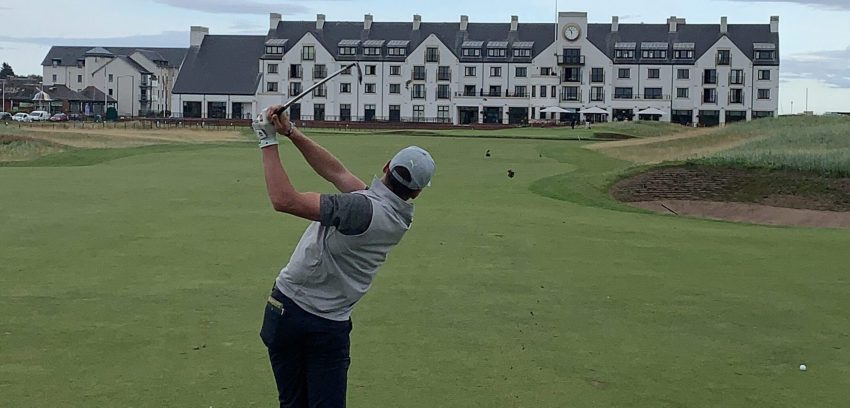
Approach to the 18th, Carnoustie
The second shot at Carnoustie’s home hole (pictured above) is challenging enough – an approach must carry the Barry Burn to a green flanked by bunkers left and right and menaced by out of bounds beyond. But this is Carnoustie, home to one of the toughest closing stretches in golf. If you’ve made it to the 18th, you’ve already had to cross the Barry Burn – twice – on the 17th, negotiate the 250-yard par three 16th and the twisting, tight par four 15th. So by the time you contemplate your final long iron of the day, it would be forgivable to feel like a boxer coming out for the final round.
Second shot at the 2nd, Royal Dornoch
It’s one of Scottish golf’s most enduring jokes: “What is the hardest second shot in Scotland? The approach to the 2nd at Royal Dornoch.” The punchline only makes sense when you realise the 2nd is a par three, which only requires a mid-iron, even from the tips. The green is a classic ‘upturned saucer’ design, a putting surface with steep drops and pot bunkers on all sides. Any tee shot that misses the putting surface – and it’s a small target to hit on a windy day – leaves a nerve-shredding chip, putt or sand trap splash. The slightest misjudgement will result in the ball trickling back to you, or rolling off the other side of the green. Good luck!


